
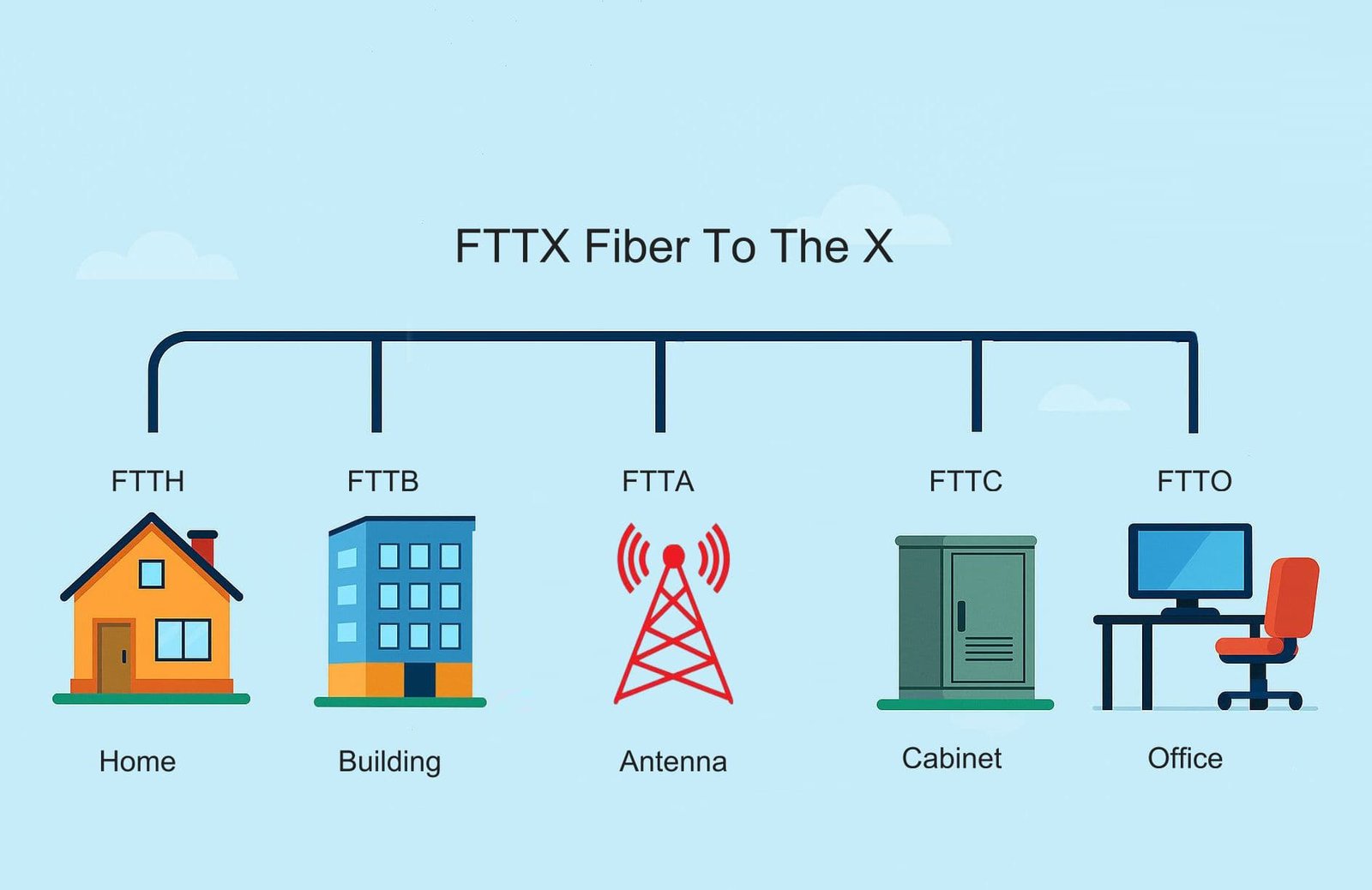
FTTX (Fiber to the X) refers to a family of broadband network architectures that use optical fiber to deliver high-speed internet closer to the end-user, replacing traditional copper lines with light-based transmission. The “X” represents the fiber’s termination point, defining the architecture’s performance, cost, scalability, and suitability for specific use cases.
As of 2026, FTTX has become the global standard for broadband infrastructure, with over 2.5 billion connections worldwide. Different FTTX types address diverse needs—from premium residential service to industrial automation, enterprise campuses, and 5G infrastructure.
This guide focuses exclusively on explaining every major FTTX type in depth: Jaringan FTTH (Fiber to the Home), FTTB (Fiber to the Building), FTTC (Fiber to the Curb), FTTN (Fiber to the Node), Bahasa Indonesia: FTTP (Fiber to the Premises), FTTD (Fiber to the Desktop), FTTE (Fiber to the Telecom Enclosure), FTTA (Fiber to the Antenna), FTTR (Fiber to the Room), FTTM (Fiber to the Machine), FTTF (Fiber to the Floor), and FTTZ (Fiber to the Zone). Each type is examined with its definition, architecture, technical characteristics, advantages, disadvantages, and comparisons to other variants.
1. FTTH (Fiber to the Home): The Gold Standard of FTTX
Jaringan FTTH (Fiber to the Home) is the most advanced FTTX architecture, where optical fiber runs directly from the service provider’s central office or headend to the individual residence, providing a dedicated fiber connection to each home.
Architecture of FTTH
FTTH typically uses Passive Optical Network (PON) technology:
- Terminal Jalur Optik (OLT): Located in the central office, serving as the starting point.
- Feeder Fiber: High-count cable from OLT to a passive splitter.
- Optical Splitter: Usually a 1×32 atau 1×64 PLC splitter in a closure or cabinet, dividing the signal.
- Distribution Fiber: Single-fiber cables to neighborhood nodes.
- Drop Fiber: Final cable to the home’s termination box.
- Terminal Jaringan Optik (ONT): Inside the home, converting optical signals to electrical for devices.
Point-to-Point (P2P) FTTH uses dedicated fiber per home without splitting.
Technical Characteristics
- Jarak: Up to 20–40 km from OLT (PON).
- Kecepatan: GPON (2.5 Gbps down/1.25 up), XGS-PON (10 Gbps symmetric), 50G-PON (50 Gbps).
- Split Ratio: 1:32 to 1:64 (higher ratios possible with advanced PON).
- Latency: <1 ms.
- Lebar pita: Symmetric gigabit+ per home.
Advantages of FTTH
- Highest possible bandwidth and symmetry.
- Lowest latency, ideal for gaming, VR, and real-time applications.
- Immune to electromagnetic interference.
- Future-proof for 100G+ speeds.
- Dedicated fiber ensures consistent performance regardless of neighbors.
Disadvantages of FTTH
- Highest installation cost due to running fiber to each home.
- Time-consuming deployment (trenching or aerial work per residence).
- Requires skilled technicians for splicing/termination.
Comparison with Other FTTX Types
FTTH outperforms FTTB/FTTC/FTTN in speed and reliability but at higher cost. It is the preferred choice for new greenfield deployments where long-term performance justifies investment.
Jaringan FTTH is dominant in leading markets like China, South Korea, and Singapore, and accelerating in Europe and North America.
2. FTTB (Fiber to the Building): Efficient for Multi-Dwelling Units
FTTB (Fiber to the Building) brings optical fiber to the building’s basement, utility room, or telecommunications closet, with the final distribution to individual units handled by copper twisted pair (VDSL) or Ethernet cables.
Architecture of FTTB
- Feeder Fiber: From central office to building ODF or termination point.
- Building Distribution: VDSL2 DSLAM or Ethernet switch in basement.
- In-Building Wiring: Existing copper telephone lines or Cat5/6 Ethernet to apartments.
PON can be used up to the building, with active equipment for vertical distribution.
Technical Characteristics
- Jarak: Fiber to building; copper last 50–200 m.
- Kecepatan: Up to 1 Gbps per unit with VDSL2+ or Ethernet.
- Split Ratio: Higher possible (1:128+).
- Latency: Slightly higher than FTTH due to copper segment.
Advantages of FTTB
- Significantly lower cost than FTTH for multi-dwelling units (MDUs).
- Faster deployment using existing in-building copper.
- Good performance for apartments and offices.
- Scalable for dense urban environments.
Disadvantages of FTTB
- Copper segment limits maximum speed and symmetry.
- Performance degrades with longer copper runs.
- Higher latency than pure fiber solutions.
Comparison with Other FTTX Types
FTTB is a cost-effective compromise between FTTH (full fiber) and FTTC/FTTN (more copper). It is widely used in high-rise apartments where running fiber to each unit is impractical.
FTTB is common in Europe and urban Asia for retrofitting older buildings.
3. FTTC (Fiber to the Curb) and FTTN (Fiber to the Node): Transitional Architectures
FTTC (Fiber to the Curb) and FTTN (Fiber to the Node) are similar architectures that extend fiber closer to homes than traditional DSL but stop short of the premises.
Architecture of FTTC
- Fiber to Curb Cabinet: Located 100–300 m from homes, containing DSLAM.
- Copper Drop: VDSL2 lines to individual homes.
Architecture of FTTN
- Fiber to Node: Larger cabinet serving 300–1000 m radius.
- Longer Copper Loops: Existing telephone lines.
FTTN is essentially FTTC with larger service area.
Technical Characteristics
- Jarak: Copper last 100–1000 m.
- Kecepatan: FTTC: 100–500 Mbps; FTTN: 50–100 Mbps.
- Latency: Higher due to copper.
- Teknologi: VDSL2 or G.fast.
Keuntungan
- Lowest fiber deployment cost.
- Quick upgrade from existing DSL.
- Uses legacy copper infrastructure.
Disadvantages
- Performance degrades significantly with distance.
- Asymmetric speeds.
- Susceptible to interference.
Comparison with Other FTTX Types
FTTC/FTTN are transitional solutions, offering better performance than pure DSL but inferior to FTTH/FTTB. Many operators use them as stepping stones to full FTTH.
4. FTTP (Fiber to the Premises): The Commercial FTTX Variant
Bahasa Indonesia: FTTP (Fiber to the Premises) is a broad term for fiber delivery to any non-residential premises, such as offices, schools, hospitals, or factories.
Architecture
Similar to FTTH but scaled for commercial needs:
- Dedicated or shared fiber.
- Higher capacity ONTs or routers.
Technical Characteristics
- Speed: 1–10 Gbps+.
- Symmetry: Full symmetric.
Keuntungan
- Gigabit+ for business-critical applications.
- Reliable for VoIP, cloud, video conferencing.
Disadvantages
- Higher cost for commercial-grade equipment.
Comparison
FTTP overlaps with FTTH but emphasizes enterprise requirements like SLAs and redundancy.
5. Specialized FTTX Types: FTTD, FTTE, FTTA, FTTR, FTTM, and More
FTTD (Fiber to the Desktop)
FTTD extends fiber directly to individual workstations.
Architecture: Fiber from switch to desk media converter or ONT.
Advantages: Ultra-low latency, 10 Gbps+ to desk, EMI immunity.
Disadvantages: High cost, complex installation.
Applications: Financial trading floors, broadcast studios.
FTTE (Fiber to the Telecom Enclosure)
FTTE fiber to intermediate telecom enclosure for zone cabling.
Advantages: Flexible intermediate distribution.
Applications: Large offices with zone boxes.
FTTA (Fiber to the Antenna)
FTTA fiber to base station antenna for 5G fronthaul.
Architecture: BBU to RRU via fiber (CPRI/eCPRI).
Advantages: High bandwidth for massive MIMO.
Applications: 5G small cells.
FTTR (Fiber to the Room)
FTTR extends fiber to individual rooms in homes.
Advantages: Gigabit Wi-Fi in every room.
Applications: Premium smart homes.
FTTM (Fiber to the Machine)
FTTM for industrial automation.
Advantages: Real-time control.
Applications: Industry 4.0 factories.
FTTF (Fiber to the Floor) and FTTZ (Fiber to the Zone)
FTTF fiber to floor distribution point in high-rises.
FTTZ fiber to zone cabinet in campuses.
Advantages: Structured intermediate points.
Applications: Large buildings.
Kesimpulan
FTTX types offer tailored solutions for every scenario—from premium FTTH to transitional FTTN.
 ID
ID  EN
EN  TL
TL  ES
ES  AR
AR  TH
TH  MS
MS  VI
VI  SW
SW  AM
AM 