
In the fast-evolving world of fiber optic networks, where FTTH connections surpass 2 billion globally and 5G/50G-PON deployments accelerate, one component quietly ensures long-term reliability: the Kufungwa kwa Sehemu ya Fiber Optic, commonly abbreviated as FOSC.
A FOSC is a protective enclosure designed to house, organize, and environmentally seal optical fiber splices, providing mechanical protection, water resistance, and easy re-entry for maintenance. Without reliable FOSC, even the highest-quality fiber cable is vulnerable to moisture, rodents, pressure, and temperature extremes — leading to costly outages.
This definitive guide explores everything about FOSC in 2025: what they are, why they matter, the major types (including dome/vertical vs horizontal/inline), detailed comparisons, installation considerations, and why the latest MST Boxes (Multiport Service Terminals) represent the cutting-edge evolution of FOSC technology.
Whether you are a telecom operator, network engineer, contractor, or procurement manager, this article — brought to you by CommMesh, a leading manufacturer of traditional FOSC and innovative MST solutions — will equip you with the knowledge to choose the perfect closure for your project.
What Is a Fiber Optic Splice Closure (FOSC)?
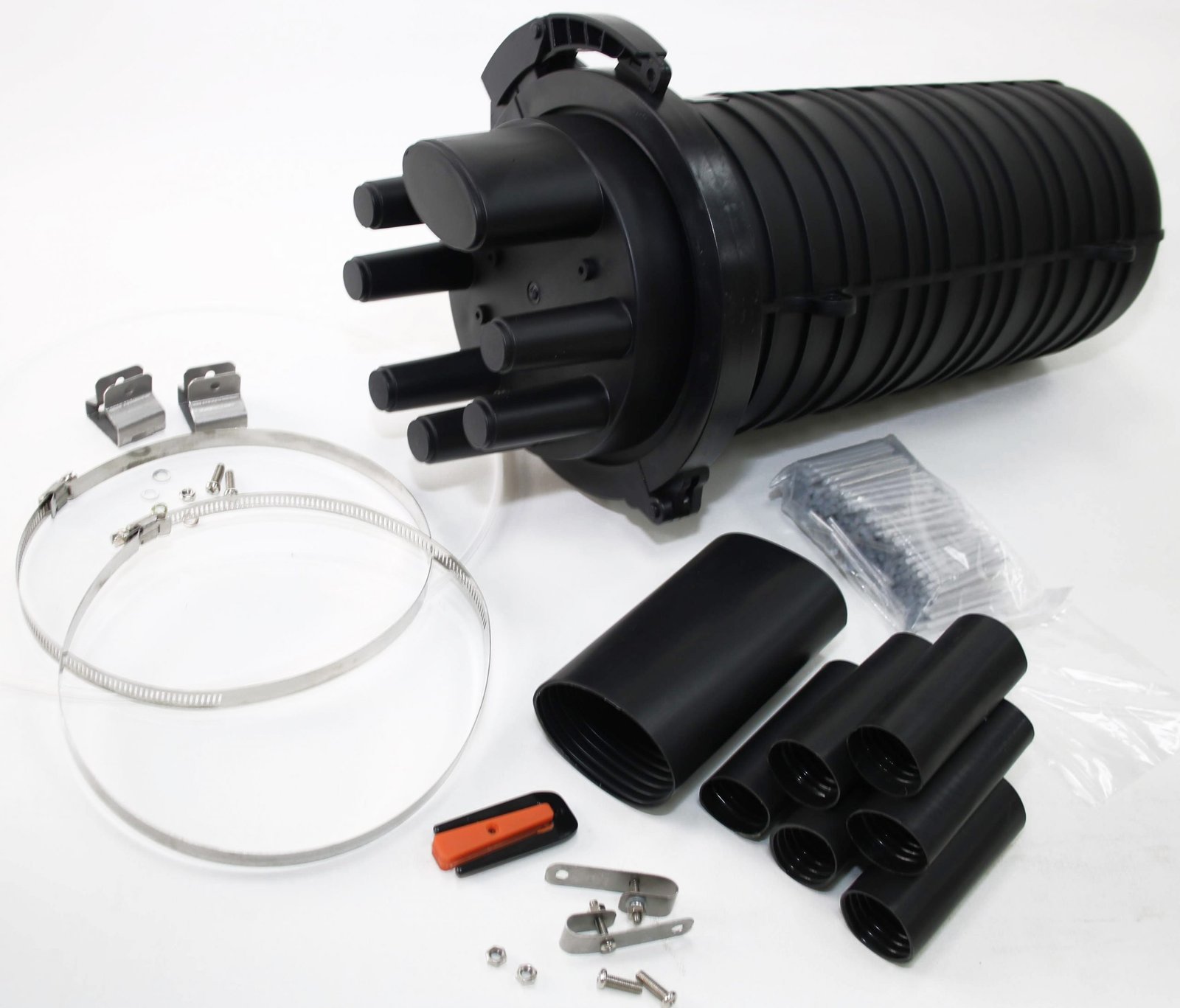
A Fiber Optic Splice Closure (FOSC) is a rugged, sealed housing that protects optical fiber splices from environmental hazards while allowing organized cable entry, splicing, and future access.
Core Functions of FOSC
- Ulinzi wa Mazingira: IP68-rated sealing against water, dust, UV, and temperature extremes (–40°C to +85°C).
- Mechanical Protection: Resistance to impact, compression, and tension.
- Splice Organization: Trays for fusion or mechanical splices (24–576 fibers typical).
- Cable Management: Strain relief, grounding, and bend radius control.
- Re-enterability: Tool-less or simple re-entry for upgrades/maintenance.
FOSC are essential in every fiber network segment: aerial, underground, manhole, pedestal, direct-buried, or facade-mounted.
Without proper FOSC, moisture ingress causes hydrogen darkening, rodents chew fibers, and pressure crushes splices — resulting in millions in annual repair costs worldwide.
The Evolution of FOSC: From Early Designs to 2025 Innovations
Early FOSC (1980s–1990s) were simple heat-shrink sleeves or basic inline boxes. The 2000s introduced dome-style closures for aerial use, while horizontal designs dominated underground.
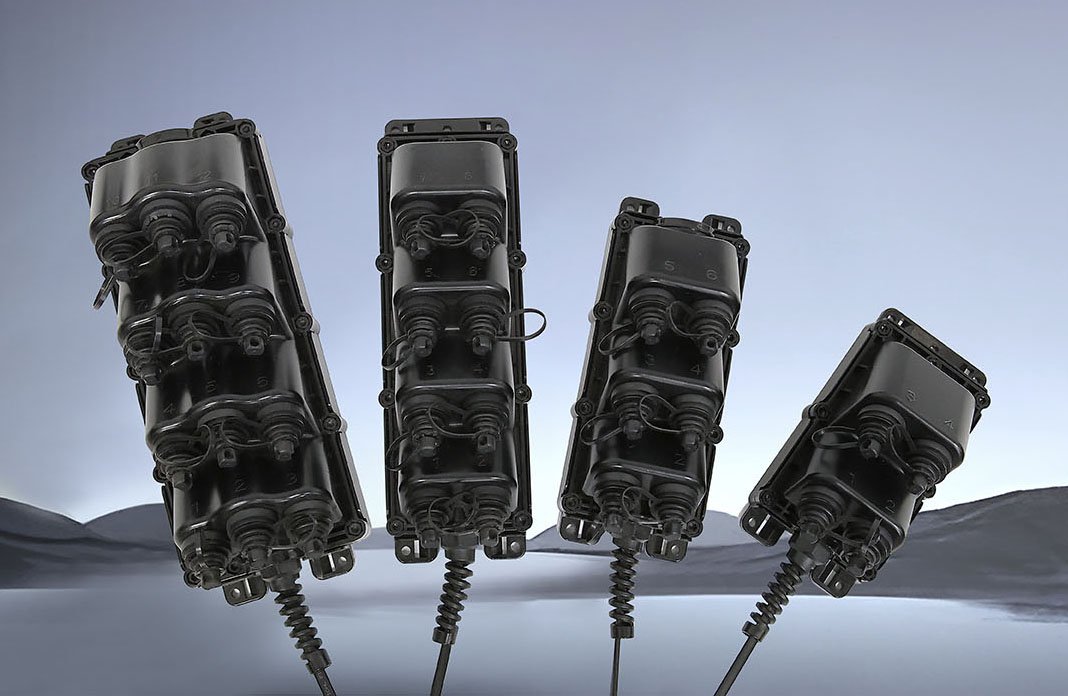
By 2010–2020, pre-terminated and plug-and-play concepts emerged, culminating in the rise of MST Boxes (Multiport Service Terminals) — a revolutionary FOSC variant that eliminates field splicing entirely.
In 2025, FOSC technology incorporates:
- Gel-free sealing
- Integrated splitters
- Smart monitoring (humidity/temperature sensors)
- Higher capacities (up to 864 fibers)
- Sustainable materials
Major Types of FOSC: Classification and Overview
FOSC are broadly classified by design, mounting, and functionality.
3.1 By Physical Design
3.1.1 Dome/Vertical Type FOSC
- Also called dome closure, dome type closure, dome splice closure, fiber dome closure, dome fiber optic splice closure
- Vertical cylindrical shape with domed end cap
- Single-end cable entry (bottom)
- Capacities: 24–576 fibers
- Ideal for aerial, pole, and manhole
3.1.2 Horizontal/Inline Type FOSC
- Also called horizontal fiber optic splice closure, horizontal junction closure, horizontal enclosure
- Clamshell inline design
- Cable entries on both ends
- Capacities: 24–288 fibers
- Ideal for direct-buried and underground
3.2 By Mounting Method
- Aerial/strand-mounted
- Pole-mounted
- Wall/facade-mounted
- Pedestal/handhole
- Kuzikwa moja kwa moja
3.3 By Functionality
- Splice-only
- With integrated splitter (for PON)
- Pre-terminated (MST Boxes)
In-Depth Comparison: Dome Type vs Horizontal Type FOSC
4.1 Design and Structure
Dome Type Splice Closures:
- Cylindrical body + domed cap
- Sealed with clamp ring and O-ring
- Cable ports at base (1 oval + 4–8 round)
- Internal basket with stacked trays
Horizontal Splicing Enclosures:
- Long rectangular clamshell
- Sealed with gasket and bolts/latches
- Ports on both ends
- Trays arranged side-by-side or hinged
4.2 Sealing and Environmental Performance
Dome Type:
- Fewer seal points → lower failure risk
- Dome shape distributes pressure evenly
- Superior in flooded manholes
Horizontal Type:
- Longer gasket → more potential leak points
- Excellent for direct-buried compression
Both achieve IP68, but dome closures often excel in water head tests (10 m for 30 days).
4.3 Capacity and Fiber Management
Dome Type:
- Higher capacity (up to 576–864 fibers)
- Stacked trays allow compact high-density
Horizontal Type:
- Typically 144–288 fibers
- Easier mid-span access
4.4 Installation and Re-entry
Dome Type:
- Fast clamp re-entry (5–10 minutes)
- Vertical orientation simplifies aerial work
Horizontal Type:
- Inline entry perfect for buried mid-span
- Bolt tightening takes longer
4.5 Applications
Dome Type Splice Closures:
- Angani FTTH distribution
- High-density feeder nodes
- Manholes in flood-prone areas
Horizontal Splicing Enclosures:
- Direct-buried trunk routes
- Underground vaults
- Mid-span splicing
4.6 Cost Comparison (2025)
| Capacity | Dome Type Price | Horizontal Price |
|---|---|---|
| 96F | $60–$90 | $55–$80 |
| 288F | $120–$180 | $100–$150 |
| 576F | $220–$320 | N/A |
Dome closures have a 10–20% premium but higher capacity per dollar.
The Revolutionary Evolution: MST Boxes as Next-Gen FOSC
While traditional dome and horizontal FOSC rely on field splicing, the latest innovation is the Sanduku la MST (Multiport Service Terminal) — a pre-terminated FOSC variant that is rapidly replacing splicing in FTTH last-mile.
5.1 What Is an MST Box?
An MST Box is a hardened, multi-port FOSC with factory-installed hardened connectors (OptiTap, Mini-SC, etc.) instead of splice trays.
Key features:
- 4–24 output ports (pre-connectorized)
- Input: stubbed cable or splice-in
- No field splicing required
- Plug-and-play drop connections
5.2 Why MST Boxes Are Taking Over in 2025
| Factor | Traditional FOSC (Splicing) | MST Box (Pre-terminated) |
|---|---|---|
| Installation Time per Drop | 45–90 minutes | 5–15 minutes |
| Skill Required | High (fusion splicing) | Low (plug in) |
| Weather Dependency | Juu | Hakuna |
| First-Time Success | 85–92% | 99%+ |
| Total Cost per Home | $180–$350 | $120–$220 |
Real-world savings: 35–50% lower installed cost, 70% faster activation.
5.3 CommMesh’s Latest MST Boxes (2025 Flagship)
CommMesh’s MST Product:
- 4–24 ports
- ≤0.25 dB insertion loss per port
- IP68 + IK10
- Integrated RFID tracking
- Compatible with OptiTap, Mini-SC, full SC/APC
- Stub lengths up to 500 m
These are the most advanced FOSC solutions available today.
Choosing the Right FOSC for Your Project
| Scenario | Recommended Type |
|---|---|
| Aerial high-density feeder | Dome Type Splice Closure |
| Direct-buried trunk | Horizontal Splicing Enclosure |
| FTTH last-mile distribution | MST Box (pre-terminated) |
| Flood-prone manhole | Dome Type |
| Mid-span underground access | Horizontal Type |
| Rapid deployment / low skill | Sanduku la MST |
Conclusion: The Future Is Pre-Terminated
Traditional Dome Type Splice Closures na horizontal splicing enclosures remain essential for backbone and high-count splicing.
But for modern FTTH and 5G last-mile, MST Boxes — the evolved FOSC — deliver unmatched speed, reliability, and cost savings.
CommMesh leads this transition with the industry’s most innovative MST and traditional FOSC portfolio.
Ready to future-proof your network? Contact CommMesh for the latest MST Box samples or customized FOSC solutions.
 SW
SW  EN
EN  ID
ID  TL
TL  ES
ES  AR
AR  TH
TH  MS
MS  VI
VI  AM
AM 