
In the era of 400G, 800G, and emerging 1.6T Ethernet, parallel optics have become the backbone of data center interconnects (DCI), hyperscale facilities, and high-performance computing. At the center of these parallel optic systems are เอ็มพีโอ และ MTP connectors — the multi-fiber push-on connectors that enable 8, 12, 16, 24, or even 32 fibers in a single ferrule.
But here’s the question every network architect, procurement manager, and cabling contractor asks in 2025: MTP vs MPO — what’s the difference, and which one should I choose?
This comprehensive guide answers that question exhaustively. We explore the history, technical specifications, performance differences, compatibility, cost implications, real-world use cases, installation best practices, and future trends for both MPO and MTP connectors.
Written by CommMesh — a leading manufacturer of both standard MPO and premium MTP® assemblies serving global hyperscalers and enterprises — this article provides unbiased, data-driven insights to help you make the right decision for your 2025–2030 network roadmap.
The Basics: What Are MPO and MTP Connectors?
1.1 MPO — The Generic Standard
เอ็มพีโอ stands for Multi-fiber Push-On/Pull-off, defined by the IEC-61754-7 and TIA-604-5 (FOCIS-5) standards. It is the generic, open-standard multi-fiber connector that can be manufactured by any company.
Key features of the MPO standard:
- Rectangular ferrule with two alignment pins (male) or holes (female)
- Fiber counts: 8, 12, 16, 24, 32 (12 and 24 most common)
- Single-mode (angled APC) or multimode (flat PC) polish
- Push-pull coupling mechanism
- High-density: up to 72 fibers per 1U panel with 24-fiber MPO
MPO is the “category” — like saying “USB-C” for cables.
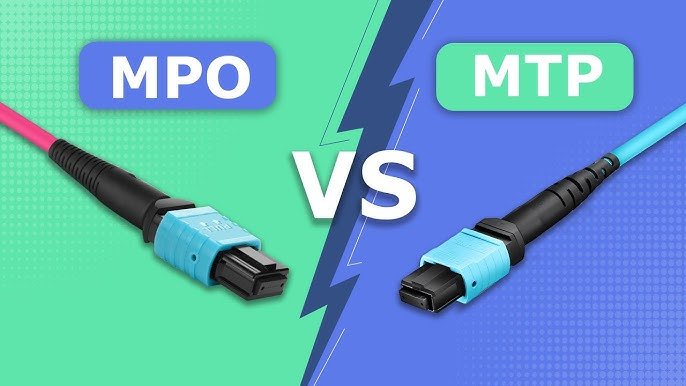
1.2 MTP® — The Premium Brand
MTP® is a registered trademark of การประชุมสภายุโรปสหรัฐอเมริกา. It is a specific, high-performance implementation of the MPO standard.
MTP connectors are engineered with proprietary enhancements:
- Floating ferrule for improved physical contact
- Elliptical guide pins for better alignment
- Removable housing for polarity changes and re-polishing
- Higher spring force for consistent mating
- Tighter tolerance ferrule and guide pins
MTP is the “Apple” of MPO connectors — fully compliant with the standard but with premium engineering.
Physical and Mechanical Differences
| คุณสมบัติ | Generic MPO | US Conec MTP® |
|---|---|---|
| Ferrule Design | Fixed | Floating (improves contact) |
| Guide Pin Shape | Round | Elliptical (better alignment) |
| Guide Pin Tolerance | มาตรฐาน | Tighter (±0.001 mm) |
| Spring Force | มาตรฐาน | Higher & optimized |
| ที่อยู่อาศัย | Fixed | Removable (gender/polarity change) |
| วัสดุปลอกหุ้ม | Standard composite | High-grade thermoplastic |
| Endface Geometry Control | Good | Excellent (lower IL) |
These mechanical improvements result in measurable performance gains.
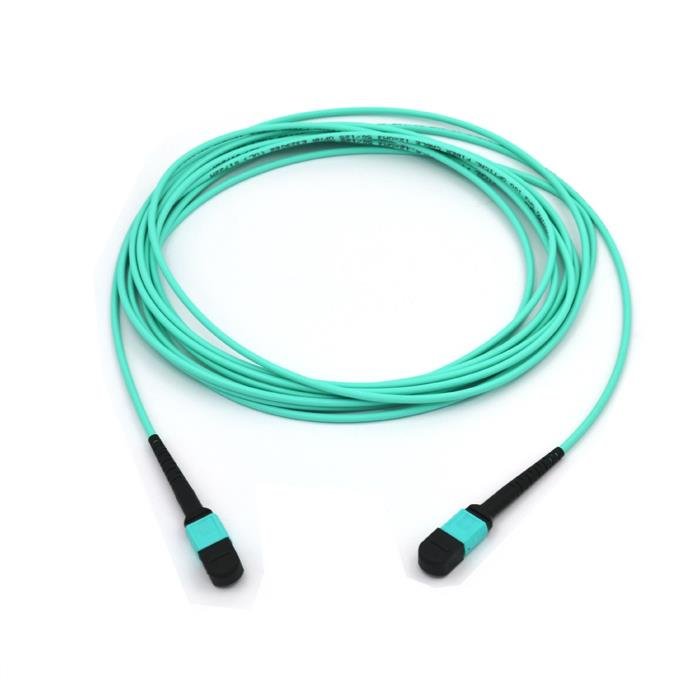
Optical Performance Comparison (2025 Real-World Data)
| พารามิเตอร์ | Generic MPO (Premium Tier-2) | US Conec MTP® Elite |
|---|---|---|
| Insertion Loss (Multimode) | ≤0.35 dB typical | ≤0.20 dB typical (Elite ≤0.10 dB) |
| Insertion Loss (Single-mode) | ≤0.50 dB typical | ≤0.35 dB typical (Elite ≤0.25 dB) |
| Return Loss (Multimode) | ≥30 เดซิเบล | ≥35 dB |
| Return Loss (Single-mode APC) | ≥60 เดซิเบล | ≥65 dB |
| Repeatability | ≤0.2 dB (500 matings) | ≤0.1 dB (1000 matings) |
| ความทนทาน | 500 matings | 1000+ matings |
Elite MTP connectors (low-loss version) are specifically designed for 400G/800G SR8/DR8/FR8 where total channel loss budgets are extremely tight.
Polarity Management: A Critical Difference
Parallel optics require correct polarity (fiber mapping) between transmit and receive.
MPO/MTP connectors use three polarity methods:
- Type A (straight-through)
- Type B (reversed)
- Type C (pair-flipped)
Generic MPO assemblies often have fixed polarity. MTP connectors feature removable housing, allowing field polarity changes without re-termination.
This flexibility saves thousands in rework costs.

Cost Analysis 2025 — Real Pricing Breakdown
| Assembly Type (3m, 12-fiber) | Generic MPO | MTP Standard | MTP Elite (Low-Loss) |
|---|---|---|---|
| Multimode OM4 | $18–$32 | $30–$50 | $45–$70 |
| Single-mode OS2 APC | $25–$40 | $40–$65 | $60–$90 |
| 24-fiber Multimode OM5 | $45–$70 | $75–$100 | $100–$140 |
Volume discounts (10k+): 15–30% off.
The MTP premium (30–60%) is justified by:
- Lower total channel loss → longer reach or fewer repeaters
- Higher reliability → fewer failures
- Field reconfiguration → lower OpEx
For 400G+ deployments, MTP Elite often becomes cheaper per successful link due to higher yield.
Use Cases: Where Each Connector Excels in 2025
6.1 MTP Dominates These Scenarios
- Hyperscale Data Centers: 400G/800G SR8/DR8/FR8 requiring Elite low-loss
- AI/ML Clusters: Massive parallel optics with zero tolerance for loss
- Co-location Facilities: High-density, frequent MACs needing polarity flexibility
- Enterprise 400G Upgrades: Future-proofing with removable housing
6.2 Generic MPO Is Sufficient Here
- 40G/100G SR4/LR4: Loss budgets are forgiving
- Campus Networks: Lower speeds, shorter distances
- Budget-Constrained Projects: Where cost is primary driver
Compatibility and Interoperability
Good news: MTP connectors are fully backward-compatible with generic MPO adapters.
You can mix MTP trunks with generic MPO patch cords — performance will be limited to the weaker component.
Warning: Never mix Elite low-loss with standard — loss budget mismatch.
Installation and Maintenance Best Practices
8.1 Cleaning Is Critical
Parallel optics have 12–24 fiber endfaces — contamination multiplies loss.
Use one-click cleaners designed for MPO/MTP.
8.2 Polarity Verification
Always test polarity with a specialized MPO tester before commissioning.
8.3 Inspection
Use video inspection scopes with MPO tips — every fiber must be clean and scratch-free.
8.4 Storage
Keep dust caps on at all times.
Future Trends 2025–2030
- 16-fiber and 32-fiber MPO/MTP: For 800G/1.6T SR16
- VSFF (Very Small Form Factor): SN and MDC challenging MPO in ultra-density
- Co-packaged Optics: Reducing need for external patch cords
- MTP Elite becoming standard: As 800G+ loss budgets tighten
Decision Matrix for Buyers
| Your Requirement | Choose Generic MPO | Choose MTP® |
|---|---|---|
| 40G/100G only | ใช่ | Overkill |
| 400G/800G deployment | Risky | Recommended |
| Need field polarity/gender change | เลขที่ | ใช่ |
| Ultra-low loss budget | เลขที่ | Yes (Elite) |
| Budget is primary constraint | ใช่ | เลขที่ |
| Long-term future-proofing | Limited | ใช่ |
Conclusion: The Verdict in 2025
Generic MPO connectors remain viable for legacy 40G/100G and budget projects.
But for any new deployment involving 400G, 800G, or high-density parallel optics, MTP® — especially Elite low-loss versions — is the clear winner.
The mechanical superiority, lower loss, higher durability, and field configurability of MTP connectors deliver measurable ROI through higher uptime, easier MACs, and support for next-generation speeds.
CommMesh offers both: cost-effective generic MPO for value projects and genuine US Conec MTP® Elite assemblies for mission-critical networks.
Need help choosing the right MPO/MTP solution for your 2025 rollout?
Contact us for free samples, loss budget calculations, or a customized quotation.
Your high-speed network deserves the best possible connection — don’t compromise on the connector that makes it all work.
 TH
TH  EN
EN  ID
ID  TL
TL  ES
ES  AR
AR  MS
MS  VI
VI  SW
SW  AM
AM 